The owner is the last to learn about losses. Every morning at 07:30 — the first.
At 07:30 a Telegram digest of yesterday arrives: revenue against plan, which supplier raised a price and who sells the same item cheaper, where money leaked this week, who does what today. Till, invoices, stock, shift, guests and banquets — in one place.
In DIVA that turned up 174,576 lei overpaid to suppliers in seven months — computed by the same program, figure from the database on 07.09.
You make the decisions. The system shows where to look.
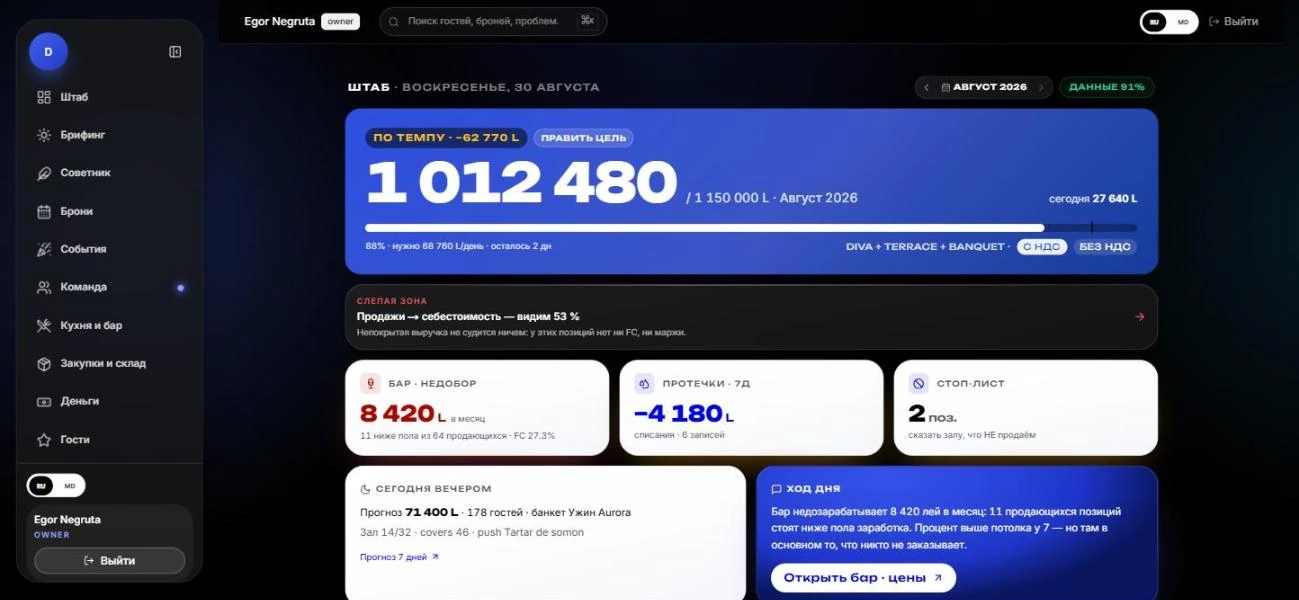
What it costs to learn last
after month-end before the accountant closes it. The invoice price gets checked after payment — if at all
overpaid to suppliers in seven months: same item, same month, cheaper at another supplier. 93 % of it — 55 items bought dear month after month
for one and the same supplier in the invoices. In pieces it ranked fourth, as a whole — first: 202,000 L in two months
of revenue had a known cost at the start. A week into the program — 98 %
All four figures come from one real restaurant, September 2026. In a meeting they are given without supplier or guest names.
Seven owner pains — in his own words
- 01
“I don't understand where the money goes.” The till says one thing, the invoices another, the stock a third.
- 02
“I'm the last to know.” About shortages — at stock-take, about a price rise — once it's paid, about an unclosed shift — in the evening.
- 03
“I have sixty suppliers and thought I had twenty.” Half under different names; nobody compares prices between them.
- 04
“Stock-take is a riddle.” There's a minus and no explanation; written off and forgotten.
- 05
“The team doesn't work without me.” Checklists, tasks, bookings — all held up by the owner's reminders.
- 06
“I don't know which of my people look at my revenue.” Access was granted; there is no log.
- 07
The main one: “I need someone who reconciles all of this every day and tells me where it leaks.” A thirty-table restaurant doesn't have that person — and won't.
What the owner gets — without a single technical word
At 07:30 in Telegram: yesterday's revenue, deviation from plan, what's on today, guests' birthdays. At 22:30 — the day in twelve counters. He doesn't ask — it arrives.
Monthly profit without an accountant. The cost of every dish and cocktail. Stock-take in money, with an explanation of which part of the shortage is a bookkeeping error.
Photo of the invoice — the check against the last delivery is done. Items you pay more for than others, and who sells them cheaper. Orders create themselves when stock drops below the threshold.
Balances, a monthly count from the phone, a log of spills and spoilage. Conference coffee breaks write themselves off by guest count.
Waiter, bartender, chef, hostess see only their tasks, shift, bookings, stop-list. Checklists with photos; overdue items surface by themselves. Sixty buttons — only for the owner.
“Why is profit lower this month?” — and a breakdown on your own figures with the first action. Its advice is judged by the till, not by itself: you see what worked.
We don't replace the till. The till records what was sold. We sit on top of it, the invoices and the stock — and tell the owner whether they agree with each other, and if not — where exactly and by how much.
iiko, Syrve, Oracle Simphony, r_keeper, Poster, Micros, Tillypad — the till stays. Plus 1C if there is one. Moldova and Romania.
Three screens to see how it differs.
Large and whole, including the one the flour came out of. These are shots from a working restaurant, not mockups. The sums are blurred because they are another restaurant’s money.
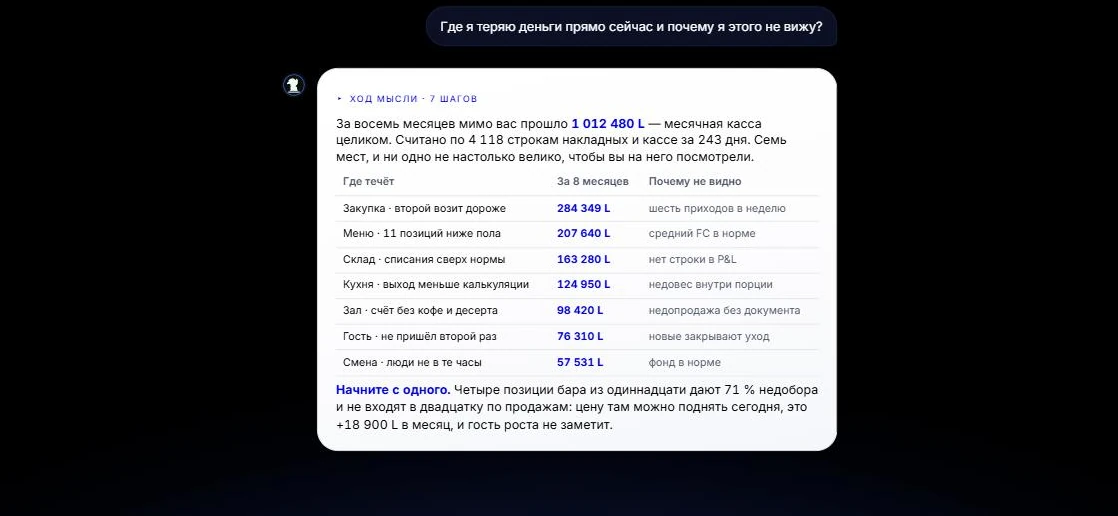
Answers like an analyst who has seen every one of your figures
The question was «where am I losing money and why can’t I see it». The answer is seven places that drained a full month of revenue over eight months, the sum for each and the reason a report never shows them. It ends with one thing to do today. Not a report, a diagnosis.
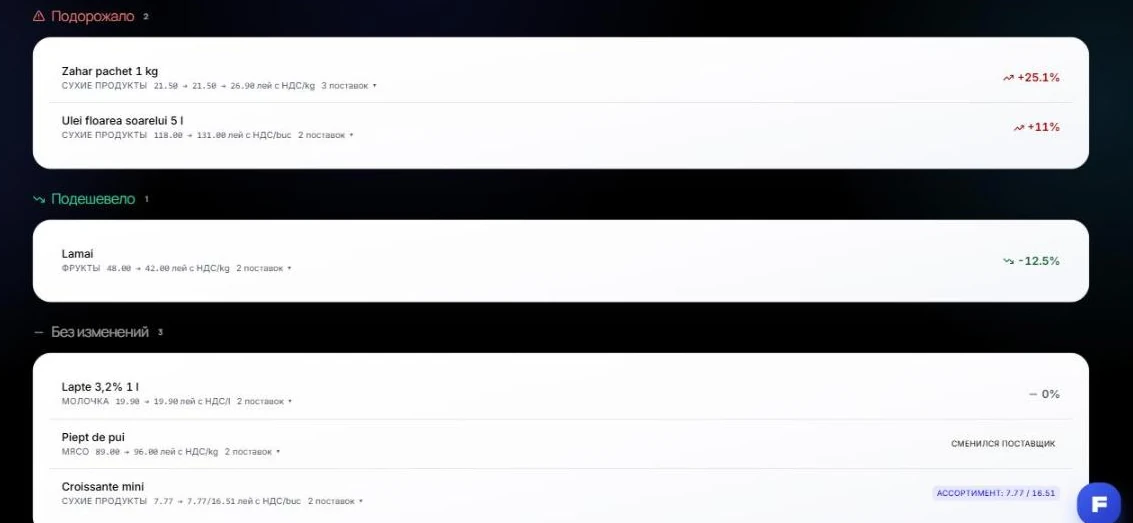
Tells a price rise apart from your own decision
This is the screen the flour case came out of. A program with a price chart would have shown a rise and sent you to argue with a supplier who raised nothing.
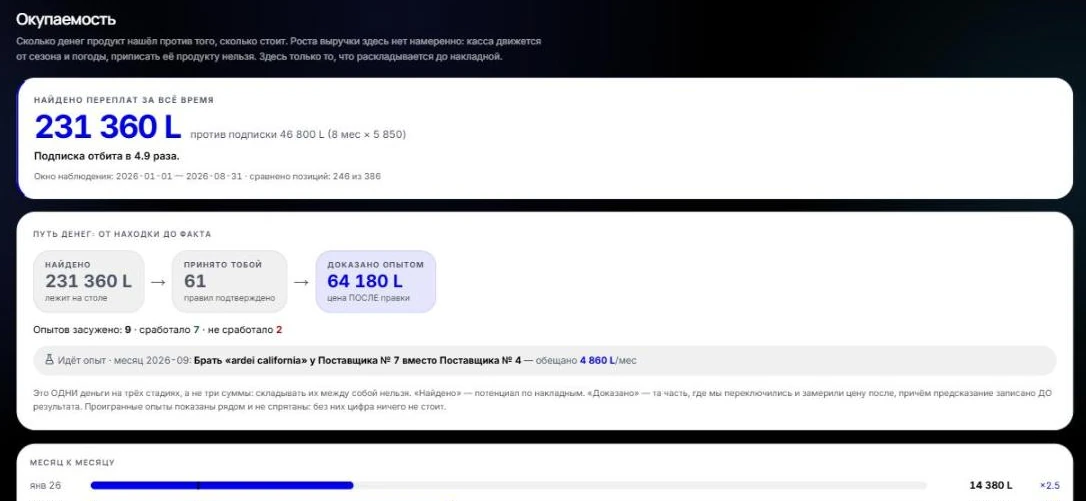
Counts itself and claims no credit that isn’t its own
Money found against what it costs, month by month. Revenue growth is deliberately left out: the till moves with the season and the weather, and taking credit for that would be dishonest.
Nine more screens out of a hundred and thirty-five.
Small here on purpose: this block is about breadth, not reading. Tap any of them to open it full size.
By morning you see whether you are ahead of plan or behind, and on exactly what
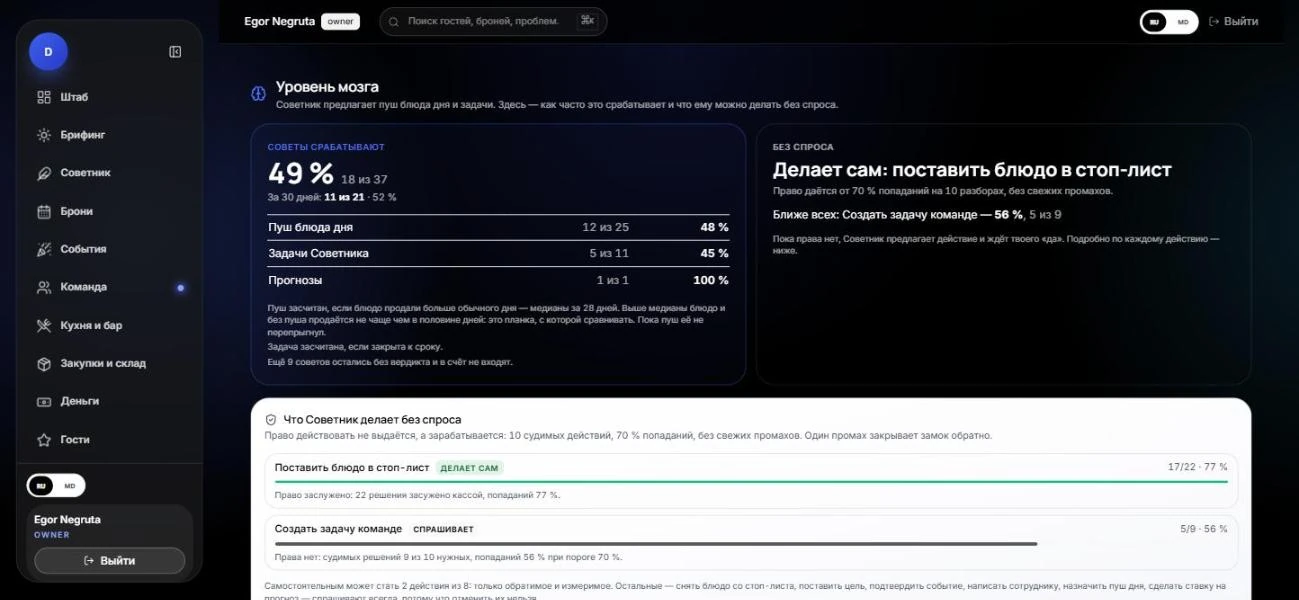
You see whether it can be trusted: its advice is judged by the till, not by itself
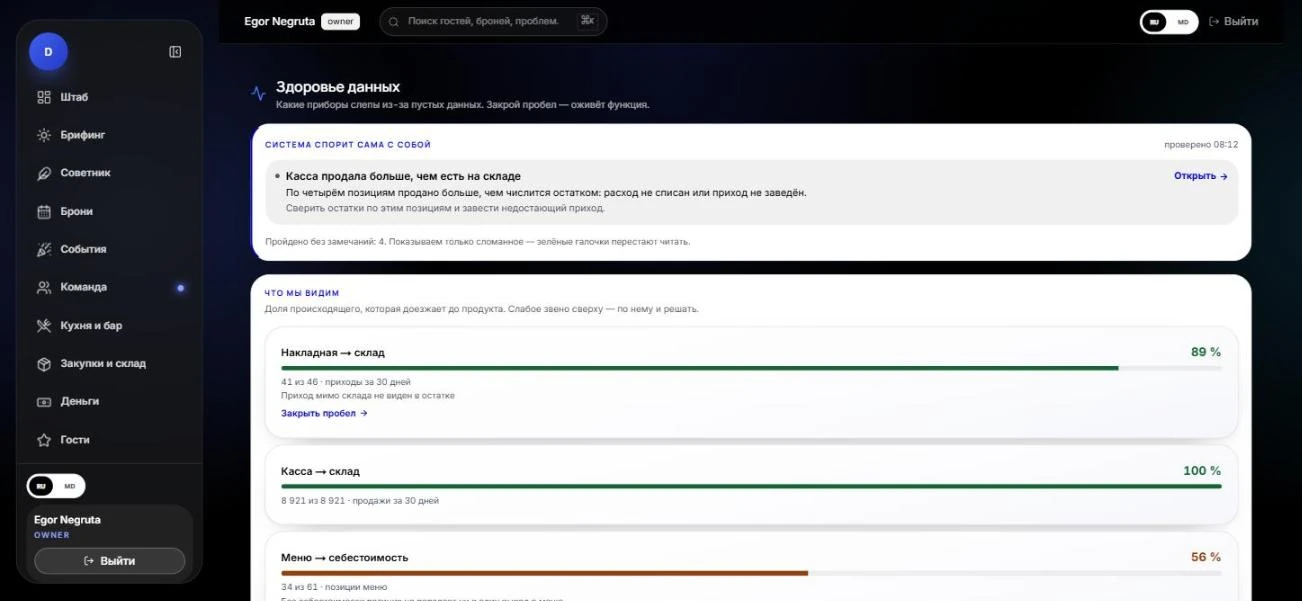
It finds where its own data lies and says which function has gone blind because of it
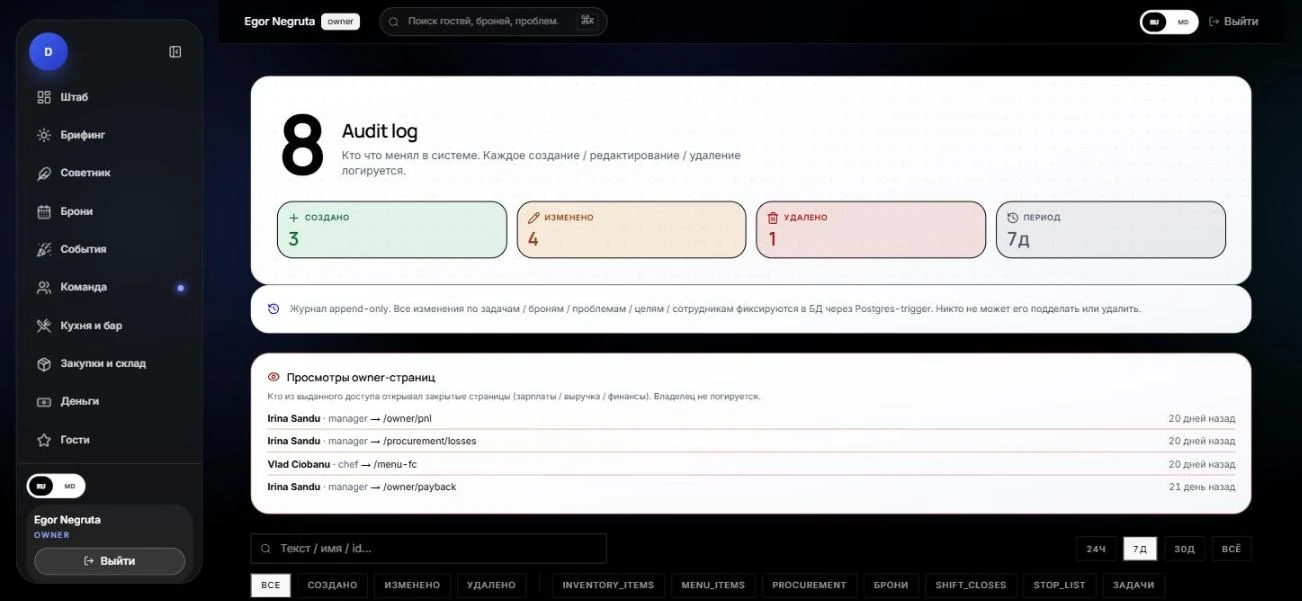
You find out who among the people you gave access to opened your revenue
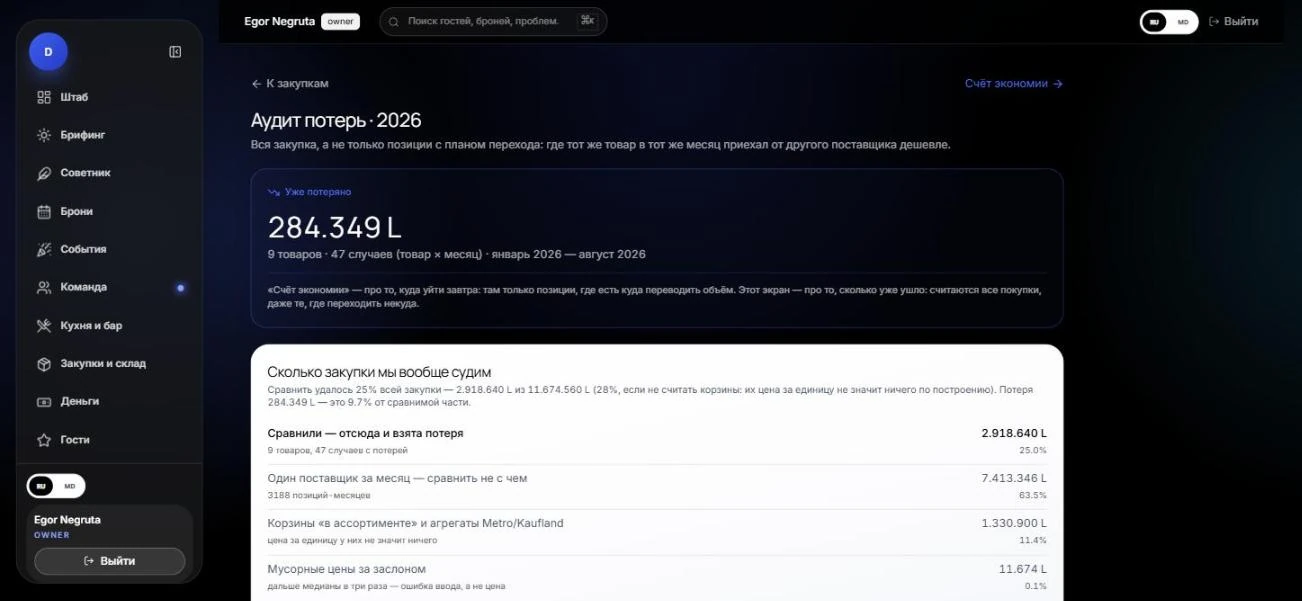
The goods you pay more for than others, and exactly who is dearer
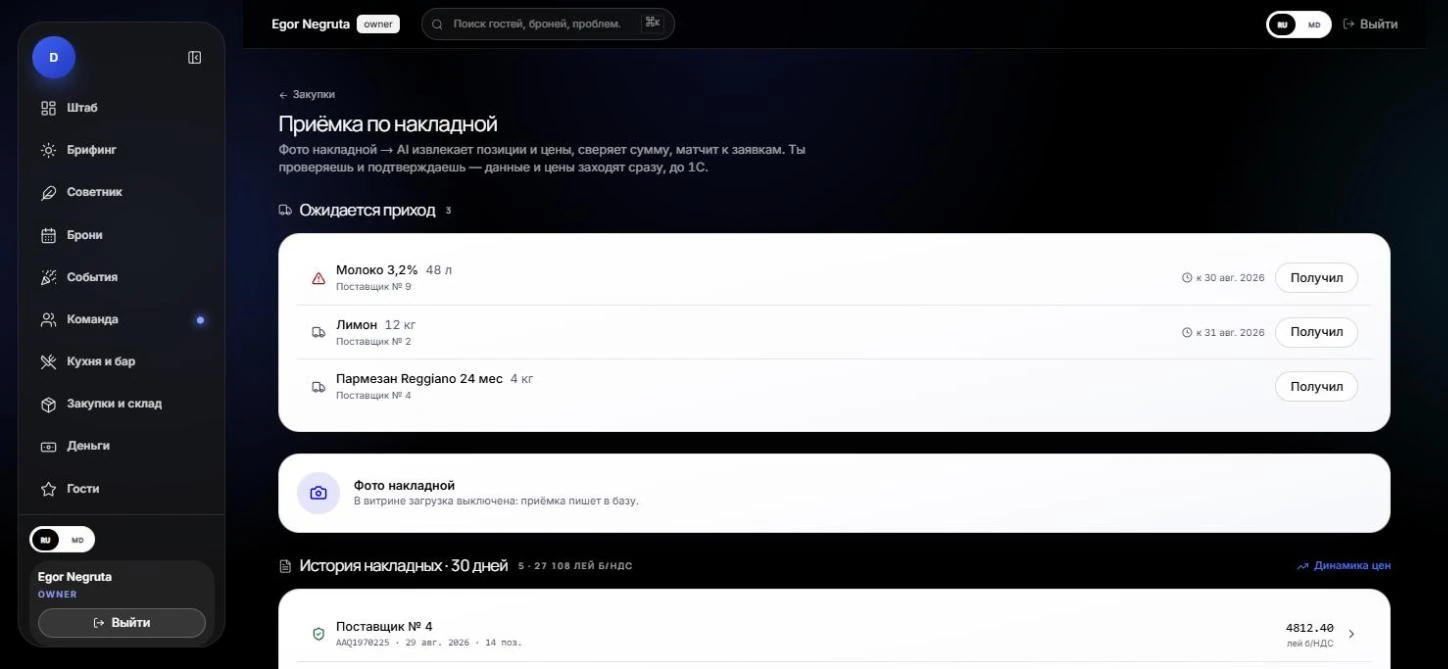
The price is caught before you pay: photograph the invoice and the check is already done
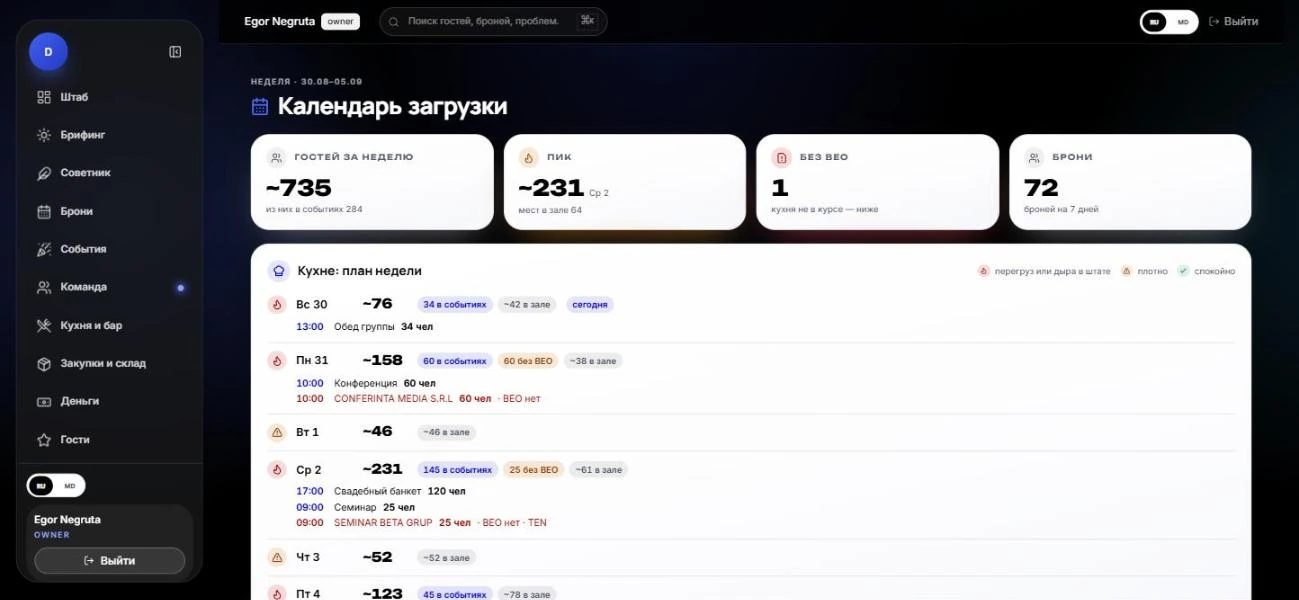
You know in advance how many guests are coming and who the shift is short of
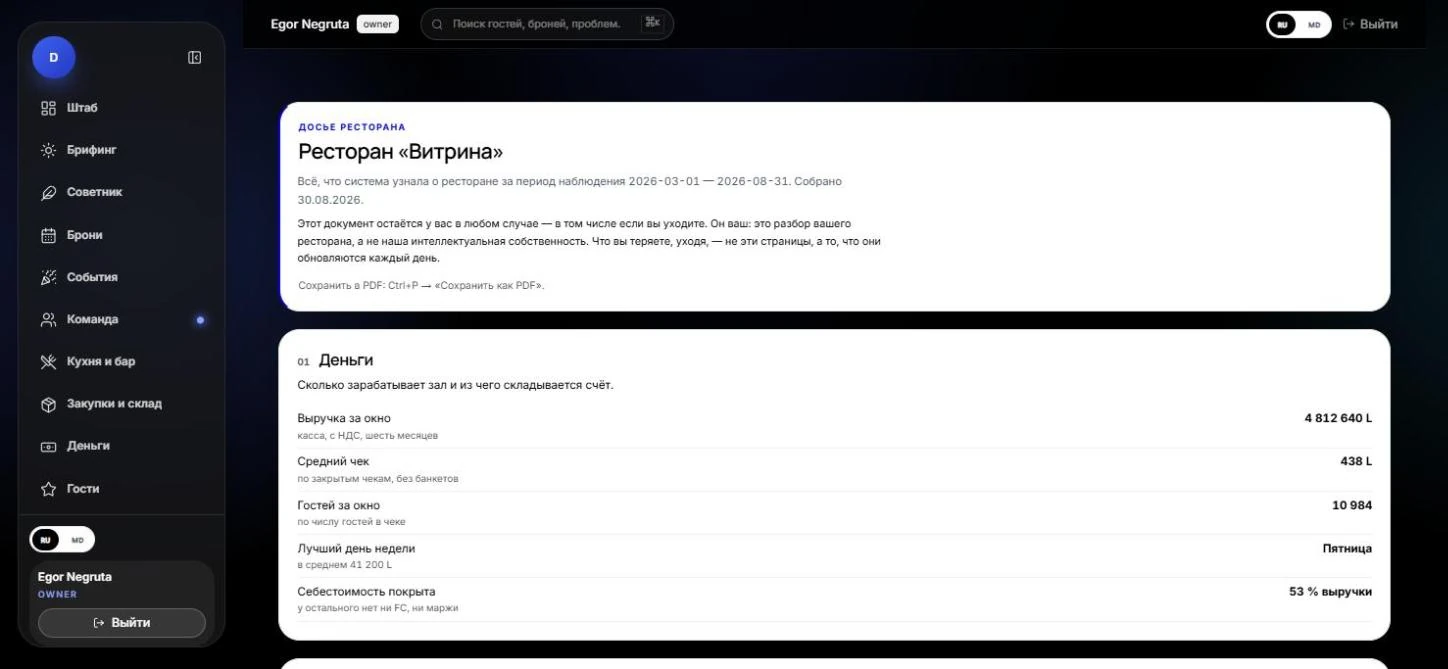
Everything the system learned about your restaurant stays with you even if you leave
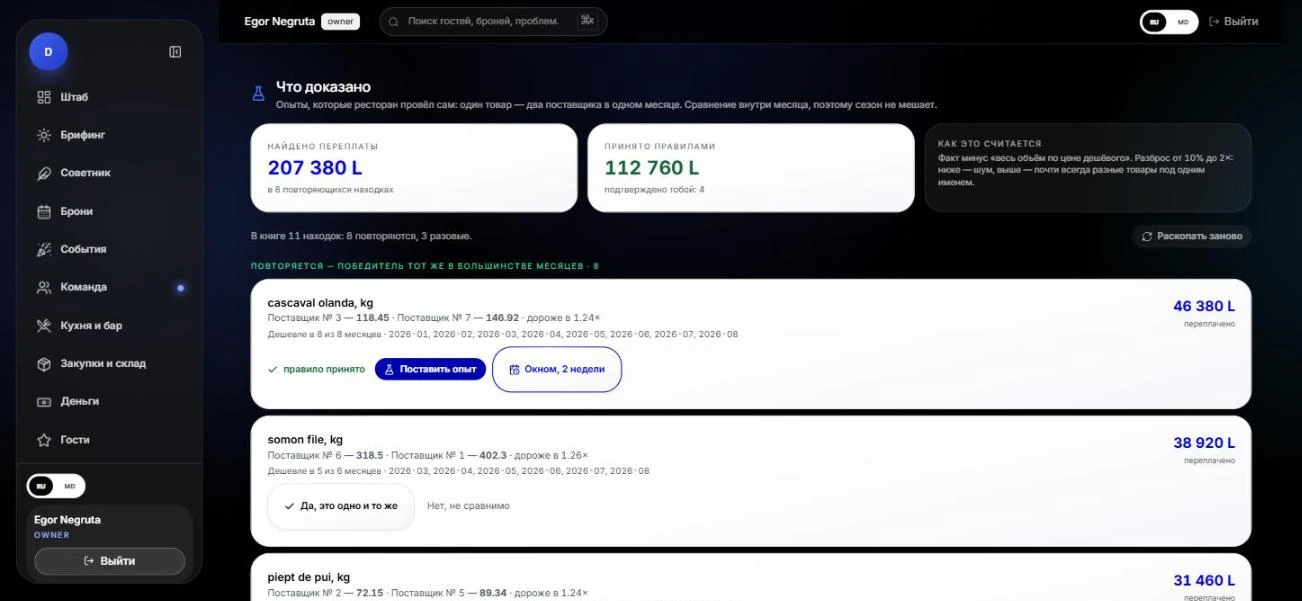
Which supplier is cheaper not once but month after month, and how much you overpaid
Bookings, guest cards and the competitor intelligence are missing on purpose. The first two carry live names and phone numbers. The third carries the names of neighbouring restaurants and a breakdown of their weak spots taken from their own reviews. We will not publish other people’s things; we show them at the meeting.
Fifty-five jobs that run without you.
Nobody opens the program to make these happen. It writes first.
- 09:10ten checks for the impossible. Silent when everything adds up
- 11:00yesterday’s till came out apart from the expectation — it speaks first
- 23:00evening summary to the owner from twelve counters
- 15 minwatchman: an unknown device, a live session of someone dismissed
- 07:35everyone on shift gets their own tasks and what is overdue
- 08:30briefing: goods in, stop list, the event, guests’ birthdays
- 15:00a regular is in the room tonight, the shift already knows
- 18:00tomorrow’s bookings
And what do you find out last?
Five questions about today, no score and no email. Every «no» opens the screen where that is visible.
- 01Before I pay an invoice I compare the price with the last delivery
- 02I know who among the people I gave access to has opened my revenue
- 03I can see the goods I pay more for than others, and who sells them cheaper
- 04When a price goes up I can tell the supplier apart from my own decision to buy dearer
- 05The evening summary comes to me on its own, I do not ask for it
An ordinary price. And a guarantee.
10–15 days. We connect your till and your accounting, move the menu and the recipes across, train the team. The system runs on your server, the keys are yours.
If in a quarter the system does not find more than the subscription costs, the next quarter is free. In a live restaurant it found three and a half times more over seven months.
We take two restaurants a month. That is not a sales device: the setup is done by hand, and it cannot be done well in three places at once.
Ninety minutes on your own data.
No presentation and no slides. We open your invoices and your till and show where exactly the restaurant is losing money. After that you decide, and even if you say no, the analysis stays with you.
direct contact: egornegruta@fenomen-brand.com
Live in the field
Tills we connect
The mechanism does not touch your till: no interference with its database, no change of hardware, no new duties for the team. Your till is not on the list, we will connect that one too.